
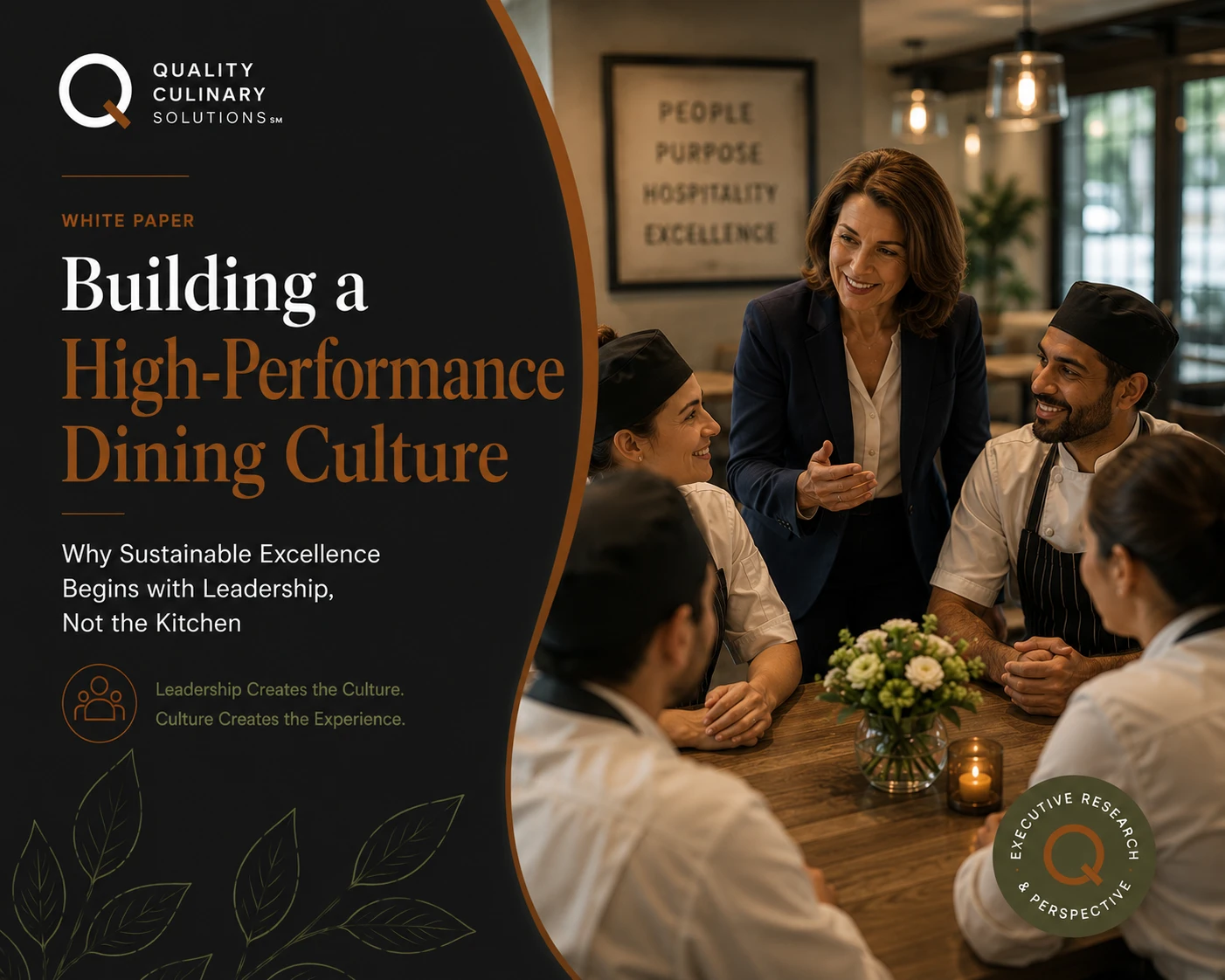
Why Sustainable Excellence Begins with Leadership, Not the Kitchen
Executive Summary
Many senior living organizations invest heavily in menus.
Some invest in equipment.
Others invest in renovations.
Far fewer invest in the one factor that consistently separates exceptional dining programs from average ones:
Culture.
Culture influences:
- Resident experience
- Employee retention
- Operational consistency
- Hospitality
- Accountability
- Continuous improvement
The strongest dining organizations understand that exceptional food is the outcome of exceptional leadership—not the starting point.
This paper explores how senior living leaders can intentionally build dining cultures that sustain excellence over time.
Culture Is the Invisible Operating System
Every dining program has a culture.
The question is whether that culture has been intentionally created.
Culture determines:
How new employees are welcomed.
How residents are treated.
How problems are solved.
How standards are reinforced.
How improvement happens.
Without intentional leadership, culture develops by default.
Why Great Teams Still Struggle
Many communities already have:
Talented chefs.
Experienced dining directors.
Dedicated servers.
Committed caregivers.
Yet resident satisfaction remains inconsistent.
Why?
Because individual talent cannot overcome inconsistent systems.
People succeed when organizations create environments where excellence is expected, supported, and reinforced.
Five Characteristics of High-Performance Dining Cultures
Leadership Creates Clarity
Everyone understands expectations.
Hospitality Is a Daily Behavior
Service becomes part of every interaction.
Accountability Is Positive
Standards are reinforced through coaching rather than criticism.
Learning Never Stops
Training becomes continuous rather than event-driven.
Improvement Is Everyone’s Responsibility
Innovation comes from every level of the organization.
Building a Hospitality Mindset
Hospitality is more than customer service.
It is intentional human connection.
It requires organizations to train behaviors such as:
- Listening
- Anticipating needs
- Personalization
- Service recovery
- Professional communication
These behaviors should become organizational standards—not individual strengths.
Leadership Shapes Culture Every Day
Leaders influence culture through:
- Recognition
- Coaching
- Visibility
- Expectations
- Accountability
Employees watch what leaders reinforce.
Residents experience the results.
The QCS Perspective
At Quality Culinary Solutions, we believe culture is one of the most underutilized performance drivers in senior living dining.
Exceptional dining experiences are not created by chance.
They are created by leaders who intentionally connect:
- Culinary Excellence
- Hospitality
- Leadership
- Systems
- Continuous Improvement
When culture becomes intentional, consistency follows.
Conclusion
Buildings can be renovated.
Menus can be rewritten.
Technology can be upgraded.
Culture requires leadership.
The organizations that intentionally build high-performance dini