
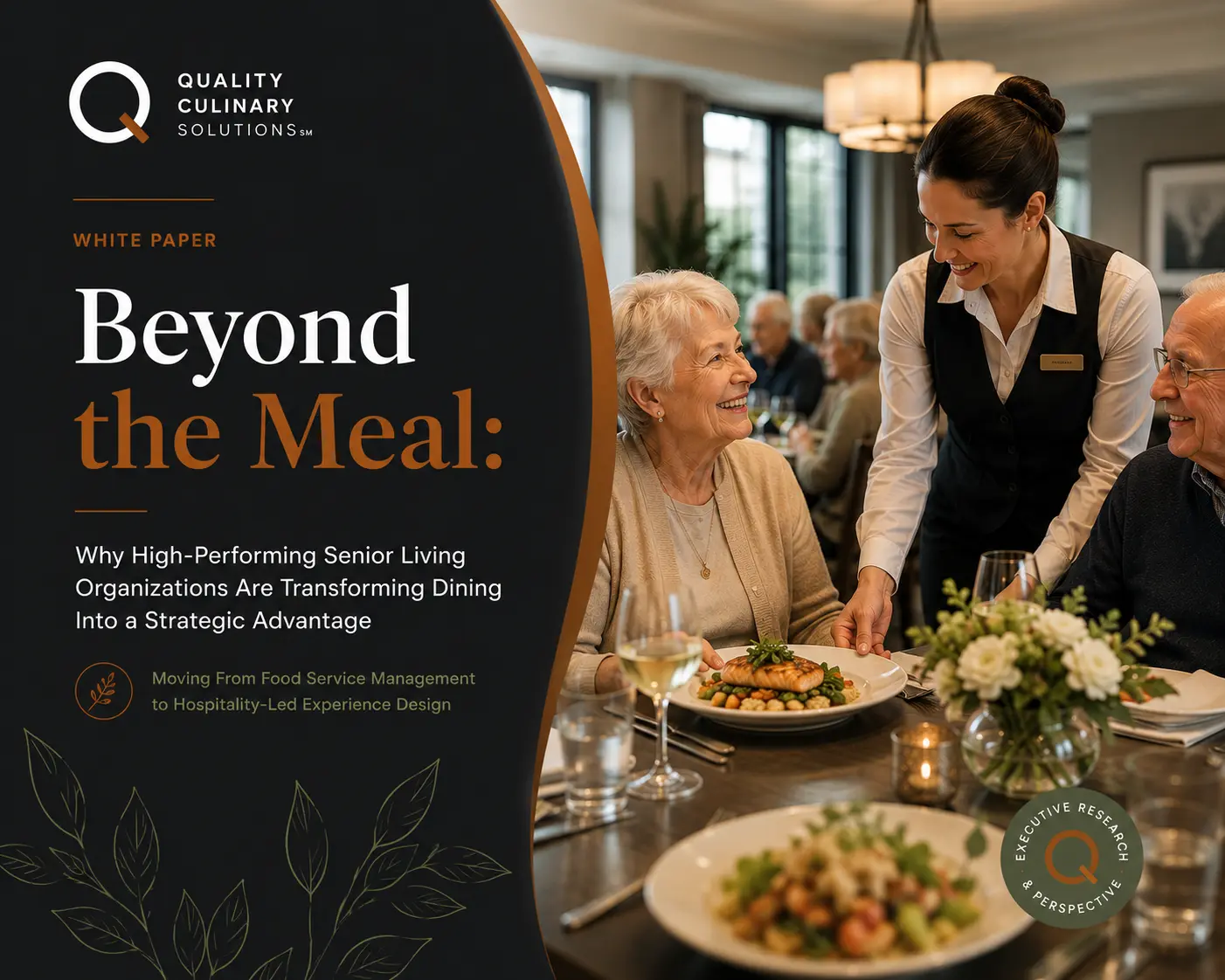
Moving From Food Service Management to Hospitality-Led Experience Design
Quality Culinary Solutions
Executive Summary
For decades, dining in senior living has often been viewed through a narrow operational lens:
- Food cost management
- Labor efficiency
- Regulatory compliance
- Menu execution
While these elements remain critical, the expectations of today’s residents and families have fundamentally changed.
Dining is no longer simply a required service.
It is one of the most visible expressions of a community’s culture, hospitality, and commitment to quality.
As senior living organizations navigate increased competition, evolving consumer expectations, workforce challenges, and financial pressure, leading operators are recognizing a critical opportunity:
Dining can become a strategic differentiator.
The organizations that thrive will not be those that simply serve meals efficiently. They will be those that create dining experiences that residents value, employees are proud to deliver, and leadership can sustainably support.
Quality Culinary Solutions believes the future of senior living dining will be defined by the intersection of:
Culinary Excellence + Hospitality Experience + Operational Discipline + Data-Driven Performance
The Changing Senior Living Landscape
Residents Are Choosing Experiences, Not Just Accommodations
Senior living has entered a new era of consumer expectations.
Today’s residents are more informed, more independent, and more accustomed to hospitality experiences outside the community environment. They compare their dining experience not only against other senior living providers, but against restaurants, hotels, and hospitality brands they have experienced throughout their lives.
The expectation has shifted:
From:
“What meal is being served?”
To:
“What experience does this community create every day?”
The dining program has become a reflection of the overall brand promise.
This shift is occurring at a time when demand for senior living continues to strengthen. NIC data shows senior housing occupancy has continued rising, reaching 89.1% at the end of 2025, creating an environment where communities must increasingly differentiate through quality and experience.
The Problem With Traditional Dining Models
Many senior living organizations have invested heavily in operational improvements, yet continue to experience common challenges:
Inconsistent Resident Experience
Great dining experiences often depend on individual leaders or frontline team members rather than repeatable systems.
When success depends on individual effort alone, consistency becomes difficult to maintain.
A Focus on Cost Instead of Value
Food and labor costs are important metrics.
However, cost reduction alone does not create a better dining program.
The strongest organizations focus on:
How do we create more value with the resources we have?
Operational Silos
Dining performance is impacted by multiple interconnected areas:
- Culinary execution
- Procurement
- Workforce planning
- Training
- Resident engagement
- Technology
- Leadership alignment
When these areas operate independently, opportunities are missed.
The New Model: Dining as a Strategic Operating System
High-performing dining programs are built intentionally.
They connect culinary expertise with operational systems and measurable outcomes.
At QCS, we believe successful dining programs are built around five interconnected capabilities:
1. Culinary Excellence
Exceptional dining begins with food residents want to enjoy.
This requires:
- Purposeful menu development
- Culinary creativity
- Seasonal programming
- Recipe consistency
- Production standards
- Chef engagement
The goal is not simply meeting nutritional requirements.
The goal is creating meals residents look forward to.
2. Experience Design
Dining is hospitality.
Every interaction matters:
- How residents are greeted
- How meals are presented
- How choices are offered
- How dining spaces feel
- How teams engage residents
The dining room should feel less like a cafeteria and more like a restaurant experience.
3. Operational Excellence
Great experiences require strong systems behind the scenes.
Operational excellence includes:
- Labor optimization
- Standard operating procedures
- Production workflows
- Training systems
- Technology utilization
- Performance measurement
The objective:
Create consistency without eliminating personalization.
4. Financial Performance
The best dining programs balance quality and financial responsibility.
Strategic operators focus on:
- Supply chain optimization
- Vendor management
- Purchasing analytics
- Menu engineering
- Waste reduction
- Productivity improvement
Financial discipline creates the ability to reinvest.
5. Continuous Improvement
Dining excellence is not a one-time project.
It requires ongoing evaluation:
- Resident feedback
- Operational reviews
- Leadership coaching
- Data analysis
- Performance improvement plans
The strongest programs continuously evolve.
The Business Case for Better Dining
A high-performing dining program impacts more than food.
It influences:
Resident Satisfaction
Dining remains one of the most frequent and visible resident touchpoints.
A positive dining experience strengthens:
- Community engagement
- Resident loyalty
- Family confidence
- Overall perception
Employee Engagement
Teams perform better when they have:
- Clear expectations
- Strong training
- Better processes
- Leadership support
A well-designed dining program improves the employee experience as well.
Operational Performance
Better systems create:
- Greater consistency
- Better cost control
- Improved accountability
- Stronger decision-making
Case Example: Creating Value Without Increasing Cost
Legacy Retirement Communities partnered with QCS to enhance dining operations across multiple communities.
Rather than recommending a complete operational overhaul, QCS focused on targeted improvements:
- Implementation of a full-service room service model
- Transformation of spaces into full-scale pub environments
- Introduction of a modern POS system
- Vendor and supply chain optimization
The supply chain analysis generated more than $100,000 in savings, allowing Legacy to fund dining enhancements while remaining budget neutral.
The result:
A more hospitality-driven dining experience supported by stronger operational and financial performance.
The Future of Senior Living Dining
The future of dining will not be defined by who can reduce costs the most.
It will be defined by organizations that can create the greatest value.
The next generation of senior living dining programs will:
- Operate with the discipline of a business
- Deliver experiences inspired by hospitality
- Use data to drive decisions
- Empower culinary teams
- Create measurable resident impact
Dining is no longer a support function.
It is a strategic advantage.
Conclusion
Senior living organizations do not need to choose between exceptional dining and operational performance.
The best organizations achieve both.
By connecting culinary excellence, hospitality, operational systems, and financial strategy, dining becomes more than a service.
It becomes a differentiator.
About Quality Culinary Solutions
Quality Culinary Solutions partners with senior living organizations to strengthen self-operated dining programs through culinary innovation, operational excellence, hospitality training, financial optimization, and data-driven insights.
Culinary-First. Data-Driven. Results-Focused.